
Key Takeaways
- AgentRVOS introduces a training-free approach that improves object segmentation in videos.
- It combines the strengths of a Masked Image Model (SAM3) and a Multi-Modal Language Model (MLLM) for better performance.
- The method shows state-of-the-art results across various benchmarks, demonstrating its effectiveness in real-world applications.
Quick Summary
Referring Video Object Segmentation (RVOS) is an emerging field that focuses on identifying and segmenting specific objects in videos based on natural language queries. This technology has significant implications for various applications, including video editing, autonomous driving, and surveillance. Traditional RVOS methods rely heavily on a structured pipeline where a Multi-Modal Language Model (MLLM) selects keyframes and identifies the referred object. However, this approach has limitations, as it requires the MLLM to make decisions about the object’s location before any visual evidence is available, which can hinder accuracy and temporal coverage.
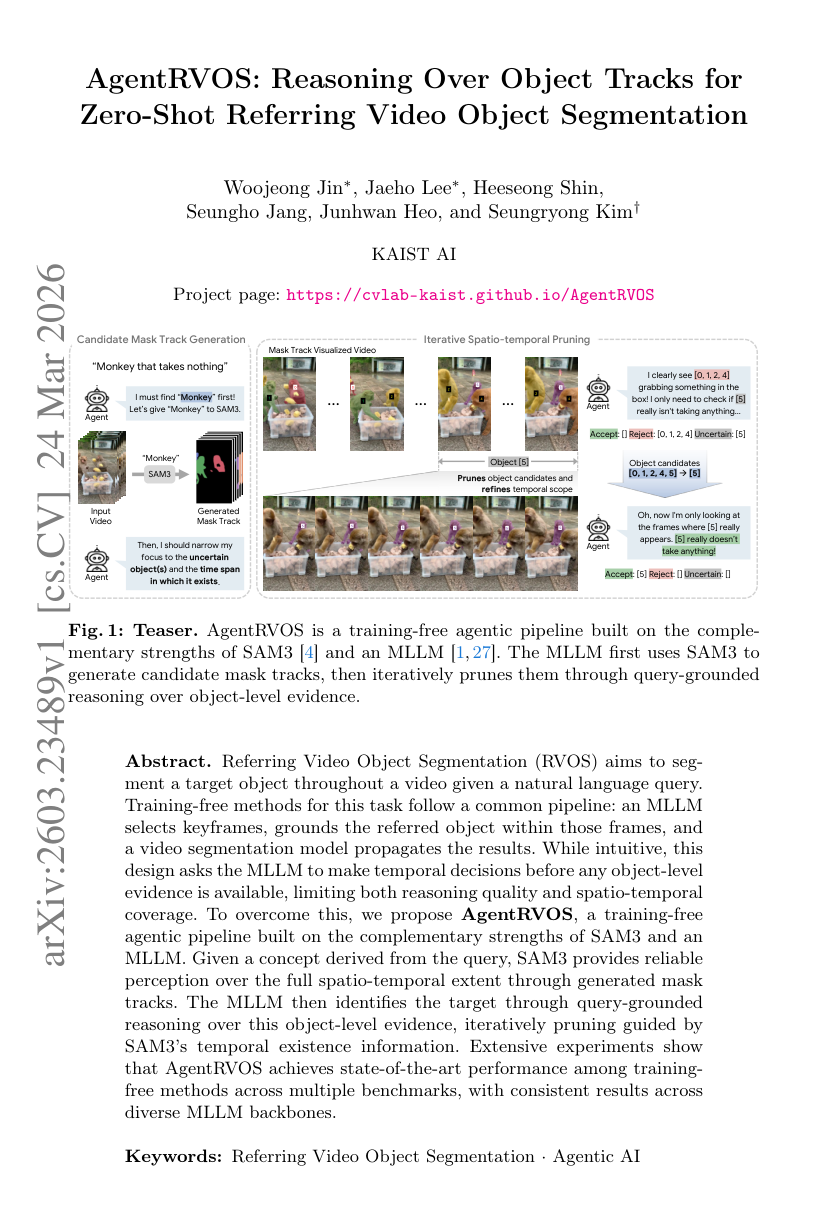
To address these challenges, researchers have developed AgentRVOS, a novel training-free framework that leverages the complementary strengths of SAM3, a Masked Image Model, and an MLLM. SAM3 excels at generating mask tracks that provide reliable visual perception across the entire video, while the MLLM focuses on reasoning based on the object-level evidence derived from these masks. This combination allows for a more informed and iterative identification process, enhancing the overall segmentation accuracy.
AgentRVOS operates by first utilizing SAM3 to generate comprehensive mask tracks throughout the video, ensuring that the temporal existence of the object is well documented. The MLLM then processes this information, grounding its reasoning in the visual evidence provided by SAM3. This iterative pruning method allows for more precise object identification, significantly improving the segmentation results.
Extensive experiments have demonstrated that AgentRVOS achieves state-of-the-art performance among training-free methods across multiple benchmarks. The results are consistent across various MLLM backbones, indicating the robustness of the approach. This advancement in RVOS not only enhances the accuracy of object segmentation but also opens new avenues for future research and applications in the field.
In conclusion, AgentRVOS represents a significant step forward in the realm of video object segmentation, showcasing how integrating different model strengths can lead to superior outcomes. This innovation could pave the way for more sophisticated and reliable video analysis tools in various industries.
Disclaimer: I am not the author of this great research! Please refer to the original publication here: https://arxiv.org/pdf/2603.23489v1